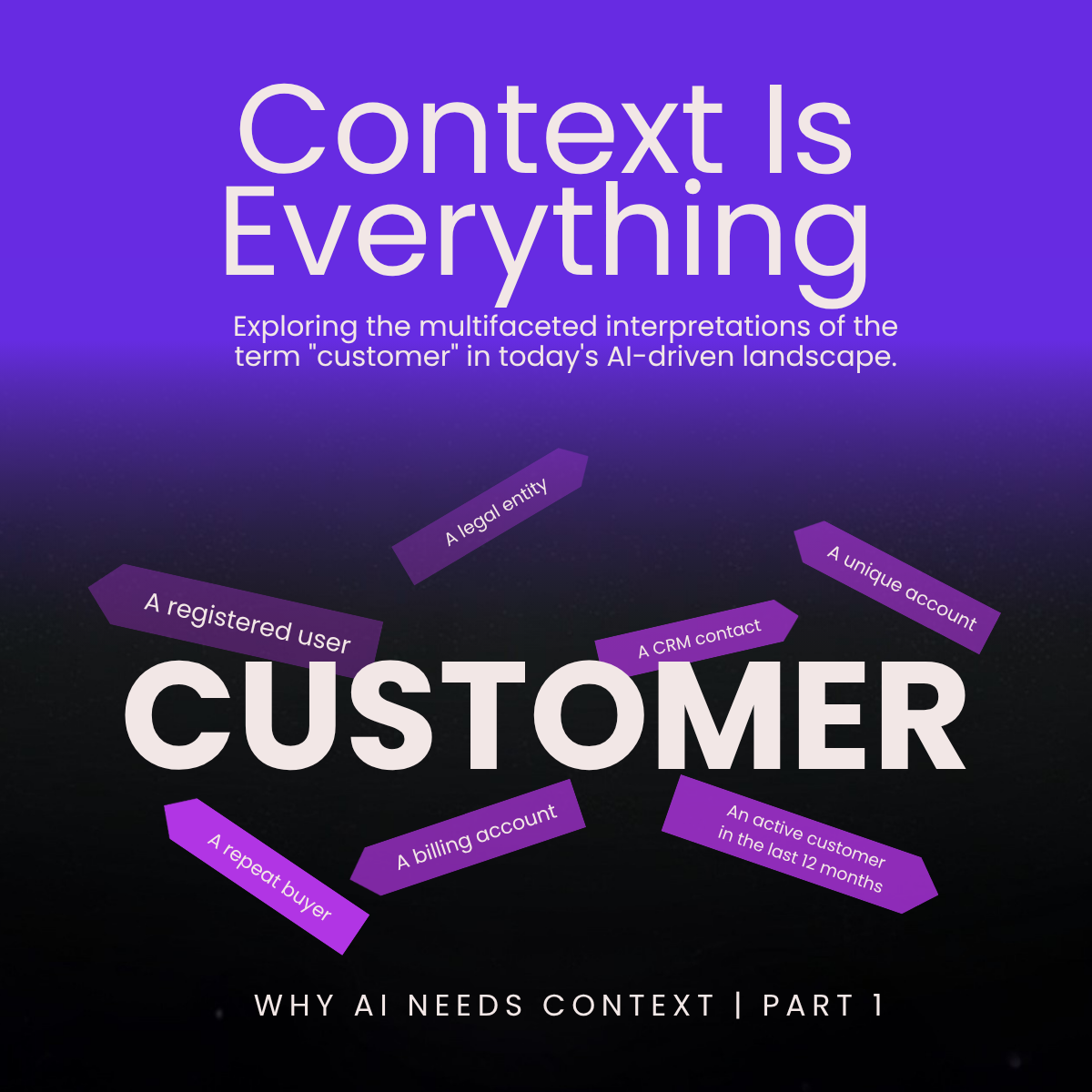
In the first article, we introduced the idea of a context gap.
Data is available. Models are capable. But the business meaning behind the data often remains implicit.
A common assumption is that AI, more specifically machine learning, can derive meaning directly from data. While this works well in many consumer AI use cases, it breaks down in enterprise environments, especially where decisions must follow deterministic logic (“if this, then that”).
Example: Net Margin
Ask any AI to calculate your net margin. It knows the formula and can perfectly recite the Wikipedia article: “Net profit margin is net profit divided by revenue. Net profit is calculated as revenue minus all expenses from total sales.”
No hesitation. It will also be able to tell you that the average operating margin for you as in Engineering & Construction is around 4%.
But if you ask it to actually compute the net margin for your company, suddenly, the issue becomes obvious:
- How does your organization recognize revenue: at delivery, at invoice, or at payment?
- Which costs are classified as cost of goods sold versus overhead?
- Are intercompany transactions included or excluded?
- How are discounts, rebates, or write-offs handled?
They define the result. And this information is usually not contained in the raw data. It lives elsewhere:
- in a revenue recognition policy stored in a SharePoint folder
- in the CFO’s mental model, refined over years
- in SAP configurations defined during an implementation project in 2017
- in spreadsheets, exceptions, and operational practices across teams
The AI is not missing intelligence. It is missing your business context.
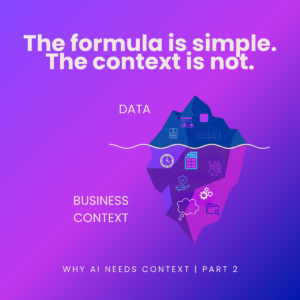
The formula is simple. The context is not.
The Iceberg of Enterprise Context
We tend to assume that most of what matters is visible in the data. In reality, enterprise data behaves more like an iceberg. The structured data, tables, fields, transactions, sits above the waterline. It is visible, accessible, and relatively easy to work with.
But a much larger part remains below the surface:
- policies
- rules
- exceptions
- contractual logic
- historical decisions
- and tacit knowledge across the organization
This is the part that gives data its meaning.
For humans, this is manageable, and often so obvious that we do not even notice it. We navigate context through experience, business process reality, and shared understanding.
For AI systems, this hidden layer is the real challenge. Because without this context, AI may hallucinate, make incorrect assumptions, or simply produce wrong results
From Data Access to Contextual Reasoning
This is why the conversation around Enterprise AI is shifting.
The challenge is no longer just how to access the data, but how to reason across business context
Enterprise AI needs to combine:
- data from multiple systems
- ontologies that define entities and relationships
- semantics that describe business meaning
- process context and business rules
- and organizational knowledge
This reflects the architecture many organizations are now building:
data → ontology → semantics → business context
Each layer adds meaning. But there is an important step here. Most approaches stop at semantics, describing what the business is. The real challenge is capturing how the business actually operates. This is sometimes referred to as federated reasoning, a term that captures the real challenge: bringing together fragmented pieces of business meaning to support decisions.
Closing
The challenge is not that enterprises lack data. And it is not that they lack business logic.
The challenge is that this logic is not explicitly represented in a way AI can use.
That is where the next layer of enterprise AI begins, and where the next question arises:
How do we ensure that AI systems make decisions that are consistent, governed, and aligned with how the business actually operates?
This is where decision logic, authority structures, and governance come into play.
That will be the focus of the next article in this series.