Humans interpret information through context.
AI systems must learn to do the same if they are to operate reliably inside organizations.
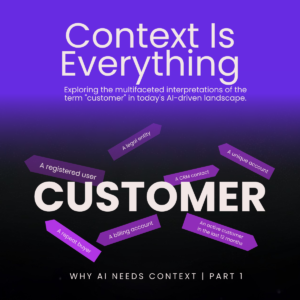
Imagine hearing the sentence: “We have 10,000 customers.” That sounds clear enough.
But what exactly is a customer?
- a legal entity
- a bill-to-party
- a buyer in the last 12 months
Inside most enterprises, different systems — and often different teams — mean different things when they say customer.
Now consider another statement: “We sold 5,000 products.” Again, it sounds straightforward. But in many companies, a product could mean:
- a physical SKU
- a service bundle
- a software subscription
- a contractual offering
Humans usually fill in this context based on experience. If something is unclear, we ask questions. Even then, interpretation can be risky because it often relies on unspoken assumptions.
AI systems work differently. They rely on patterns learned during training. They can reproduce general knowledge extremely well — but they usually lack the company-specific context that gives enterprise data its real meaning.
The Hidden Layer of Meaning
Data rarely speaks for itself. Behind every number, every data field sits a layer of business meaning:
- definitions
- policies
- operational practices
- business rules
- shared understanding within teams
Humans rely on this layer constantly. We interpret numbers and statements not just by reading the data, but by understanding the context in which that data exists. This ability allows people to operate effectively in complex environments. We do not simply process information — we interpret it in the context. In business, this contextual understanding shows up everywhere. Seasonal effects, business culture, ramp-up phases, pricing conventions, and contractual obligations all influence how data is interpreted. Much of this knowledge is rarely written down explicitly. Instead, it lives in the collective experience of the organization.
Why This Matters for AI
Modern AI systems — especially large language models — are extremely good at generating language. They are trained on vast amounts of text and learn statistical relationships between words, concepts, and contexts. In essence, the model learns how language tends to flow and becomes very good at predicting what information is likely to come next in a sequence (Next-Token Prediction). This capability allows LLMs to summarize documents, answer questions, generate code, and explain complex topics. But it also creates a subtle illusion.
Because the responses are fluent and coherent, people often assume the system actually understands what it is saying. This phenomenon is known as the ELIZA Effect, first described by MIT computer scientist Joseph Weizenbaum in the 1960s. Users began attributing human-like understanding to a very simple chatbot. The same tendency appears today with large language models — only at a much larger scale.
The model produces answers that sound knowledgeable which also coined the term Stochastic Parrot. Instead of understanding how your organization defines business terms such as customer, product, or revenue it parrots back what Wikipedia says. But for you these meanings are shaped by policies, processes, industry jargon, and business rules that exist outside the data itself.
The Context Gap
Much of today’s discussion about AI focuses on models:
- larger models
- more training data
- improved benchmarks
- faster GPUs
These advances are real, and they matter. But inside enterprises, a different limitation is becoming increasingly visible. AI systems can process data, generate insights, and produce convincing answers — yet they only the contextual knowledge required will make it interpret business information reliably. This is what we might call a context gap.
The data is available.
The models are capable.
But the business meaning behind the data is missing.
This growing awareness explains why concepts such as semantic layers, knowledge graphs, and business ontologies are currently receiving so much attention in the Data & AI community. Almost every data platform, analytics vendor, and AI startup is now building some form of semantic layer.
The good sign here is that experts agree on missing context as a core challenge. However, I believe most approaches cover only the surface of enterprise context. They purely describe data technically (metadata) or simply describe entities and relationships — customers, products, orders — but fail to capture operational logic. This is especially true as AI models approximate meaning and answers. They work probabilistic and not deterministic which sometimes kills precision. However, pricing rules, supplier evaluation models, approval authorities, or revenue recognition policies need to be executed with high precision. This is what makes businesses unique and where the real challenge of enterprise AI begins.
Closing
In human decision-making, context is king.
In Enterprise AI, context lives in definitions, policies, operational practices, and shared experience across teams.
AI can analyze data, recognize patterns, and generate remarkably fluent explanations. But unless the underlying business context is explicitly represented, the interpretation of that data remains uncertain. In other words, the model may process the information correctly (revenue is sum of invoices in a month) but given your business meaning (apply our specific Revenue Recognition policies) still wrong.
This is the challenge at the heart of enterprise AI. Understanding the context gap is the first step.
The next question is more difficult:
If context is so important, why can’t enterprise AI simply infer it from the data itself?
That question will be the focus of the next article.